




Ray Wong is one of the most prominent figures in Hong Kong's pro-democracy movement. After taking part in protests against the growing influence of mainland China and facing the threat of a lengthy prison sentence, he was forced to leave his home city and seek political asylum in Germany, becoming one of the first Hong Kong activists to take this path.
Today, Wong continues his work from Europe, focusing on human rights advocacy for the Hong Kong diaspora and conducting research on Beijing's activities in the city following the erosion of its autonomy.
24 Channel conducted an exclusive interview with Ray Wong to discuss the challenges and threats faced by political activists in harsh authoritarian systems, the reasons behind the failure of the protests, and the current situation inside Hong Kong, as well as the connections between the Ukrainian and Hong Kong diasporas.
Another key topic of the conversation was how what was once a leading economic hub in Asia is now being used by the Kremlin to circumvent sanctions imposed by the European Union and the United States. Special thanks to the analytical center StateWatch for providing materials.
Ray Wong's Protest Journey: From Founding a Movement to Life in Exile
To start with, could you tell a bit about yourself and your personal journey? How did you first become involved in opposition activism?
I first became involved in activism in 2014, during the Umbrella Movement, when hundreds of thousands of Hong Kong people occupied the streets outside government buildings. That was really the first time I took part seriously in a protest movement.
After that, I realized that if I didn't get more deeply involved, it might soon be too late. We could already see how rapidly Hong Kong was being "mainlandized". It became clear that if we didn't fight back then, Hong Kong would eventually turn into just another Chinese city, without real freedom or rights.
Umbrellas used by protesters to shield themselves from tear gas have become a symbol of Hong Kong's pro-democracy movement / Photo AP

In 2015, I founded my own activist group, Hong Kong Indigenous. The goal was to emphasize the uniqueness of Hong Kong's identity. We have our own culture, our own way of life, and our own values, which are distinct from those of mainland China. We also wanted people to seriously question whether the principle of "one country, two systems" could truly protect our way of living or preserve those values. Our conclusion was that the only way to safeguard Hong Kong's identity and freedoms was independence.
From the regime's perspective, that position was considered extremely radical. I was arrested multiple times. During one protest, police used brutal force, and what began as self-defense escalated into clashes between protesters and the police.
Ray Wong escorted by police outside a city court building / Photo Felix Wong

I was later charged with organizing riots – an offense that carried a potential sentence of up to ten years in prison. In 2017, just a few months before my trial was due to begin, I decided to leave Hong Kong. I knew I would not receive a fair trial. I came to Germany to seek asylum and eventually became the first Hong Kong activist to be granted asylum in a European country.
Since then, I have continued my activism. I founded a human rights organization in Berlin and remain involved in advocacy work and research across Europe.
It's been almost nine years since you first moved to Europe. What was the hardest thing for you to come to terms with?
The hardest period for me was when I was living in refugee camps. After arriving in Germany and applying for asylum, I was sent to several camps by the immigration authorities. In total, I lived in three different refugee camps, all of them located in very remote areas, basically in the middle of nowhere.
The isolation was overwhelming. I was surrounded by other asylum seekers, and everyone was under constant stress. None of us knew whether our applications would be accepted or whether we would be deported back to our home countries and forced to appeal.
Since I was the first Hong Kong activist to apply for asylum there, I genuinely had no idea whether my case would succeed. That uncertainty made the experience extremely difficult. Mentally, it was a very dark period for me, and I struggled with severe depression while living in the camps.
Things improved after I was granted asylum, but another emotionally challenging moment came during the 2019 protests in Hong Kong. Many of my friends were on the front lines every day – protesting, getting beaten, arrested, and sent to prison.
I was in Europe, watching everything from afar, unable to help in any direct way. That sense of guilt – of being safe while others were risking everything – was incredibly hard to overcome.
Why did the 2019–2020 protests in Hong Kong fail? And how would you describe the situation in Hong Kong today?
The failure of the 2019 protests was, in many ways, only the final stage of a much longer process – the failure of the entire Hong Kong pro-democracy movement. Looking back now, I would say that even before the protests began, we had already lost. China had spent decades systematically infiltrating every aspect of Hong Kong society.
If we go back to 2003, much of the business sector still stood with the pro-democracy movement. By 2014, most major business interests had already shifted to Beijing's side.
After that, we saw the rise of pro-Beijing media outlets and parallel civil society organizations designed specifically to counter the democratic camp.
Protesters on the streets of Hong Kong / Photo AFP

So when 2019 arrived, we did have enormous momentum. Two million people took to the streets. But by then, the foundations of a free society had already been deeply eroded. There was simply not enough leverage left to force the government to make real concessions. That is why, at that point, many Hong Kongers placed their hopes in international pressure – sanctions and actions by foreign governments to push back against Beijing.
Then COVID-19 hit. It gave the Hong Kong authorities time to regroup, and shortly afterward Beijing imposed the National Security Law, effectively crushing the pro-democracy movement.
The sequence of events was disastrous, but if we take a broader view, the deeper problem was that we underestimated China's long-term infiltration and united front work. This had been going on since the 1980s and 1990s – building loyal media, co-opting elites, and establishing dense underground networks of influence.
As for Hong Kong today, the situation is arguably worse than in many mainland Chinese cities. In China, when major scandals or disasters happen, officials are sometimes forced to resign. In Hong Kong now, even that minimal accountability no longer exists. After major incidents, including deadly fires, no senior officials have taken responsibility. In comparable cases in mainland China, such as in Shanghai, multiple officials were forced to step down.
A fire at a residential complex in Hong Kong took the lives of 168 people, with dozens more injured / Photo AFP

Today, Hong Kong has no meaningful freedom of the press, no real civil rights, and no opposition. Even mild criticism of the government can lead to arrest and imprisonment. That is the reality.
At the same time, this does not mean the pro-democracy movement is over. It has transformed. It is now largely a diaspora movement. We are building institutions, networks, and influence abroad. History shows that diaspora communities often play a crucial role when authoritarian regimes begin to weaken. For now, we are strengthening ourselves overseas and waiting for the opportunity to return.
Transnational Repression: How China Targets Activists Abroad
How has living abroad affected your activism? Are you able to cooperate with people inside Hong Kong from Europe?
It is extremely difficult – and dangerous. I am on the wanted list, and anyone in Hong Kong who stays in contact with me could become a target of the police.
I don't want to put anyone at risk, so maintaining direct communication with people on the ground is very complicated. Of course, I still have connections, but we have to be extremely cautious. Every interaction has to be carefully considered, because the consequences for those inside Hong Kong can be serious.
Do you face threats or pressure from China while living in Europe? And do other Hong Kong activists abroad experience similar problems?
Yes. Even though we are no longer in Hong Kong, the threats and harassment from Hong Kong and Chinese authorities continue.
One example happened about a fewyears ago, when I was in Berlin with a group of Hong Kong students meeting German politicians. After one of those meetings, we noticed a Chinese couple – I can't say for sure where they were from, but they appeared to be Chinese – who seemed to be following us.
At first, we didn't pay much attention. But when we entered a restaurant for lunch, they sat directly next to us. They didn't talk to each other at all and were clearly listening to our conversation. At that point, we strongly suspected they were there to monitor us. When we were about to leave, they openly took out their phones and photographed us. This was not subtle at all.
That was just one incident among many. Another ongoing issue is digital harassment. My email account is constantly targeted. I regularly receive security alerts from Google warning me about attempts to steal my password, sometimes describing them as potentially state-sponsored attacks. It doesn't take much imagination to guess which state that might be.
Other Hong Kong activists in Europe face similar or even worse situations. For example, in the United Kingdom, some activists have reported physical attacks, surveillance, and harassment.
There have also been cases of smear campaigns, including attempts to use AI-generated content to damage reputations. In some instances, even neighbors were targeted with anonymous letters containing false information.
These are all different forms of what we call transnational repression. Surveillance, intimidation, digital attacks, smear campaigns – almost every tactic you can think of has been used against Hong Kong activists abroad.
Ray Wong with colleague Alan Lee outside the Bundestag building in Berlin / Photo AFP

Do you receive any protection from German authorities?
I don't have any special protection. In theory, if I encounter something suspicious – for example, if I feel I'm being followed – I can report it to the police. But in reality, there is very little they can do.
The problem is that most forms of Chinese transnational repression operate below the legal threshold. Things like surveillance, stalking, or online harassment may look trivial when taken individually. If you report them, they can easily be dismissed as insignificant or not serious enough to warrant action.
What makes this dangerous is not the individual acts themselves, but the fact that they are initiated or supported by a state. These activities are systematic and coordinated, which makes them unpredictable. You never know where the line is – whether it will remain limited to online harassment and intimidation, or whether it could escalate further.
History shows that such escalation is not hypothetical. Other authoritarian states, including Russia and Vietnam, have carried out operations against dissidents abroad, including on European soil. China has also attempted to forcibly return critics from overseas. So these risks are very real, even if they are rarely acknowledged at the early stages.
Shared Challenges, Common Values: Do Hong Kong and Ukrainian Diasporas Cooperate?
You already spoke publicly about Ukraine after Russia's full-scale invasion in 2022. What are the strongest parallels you see between Hong Kong's struggle against Beijing and Ukraine's fight against Moscow?
At a fundamental level, what we are fighting for is the same. It is about independence and agency. We don't want our lives, our future, or our political system to be dictated by someone else. In the end, it is about self-determination – the right to decide what kind of country, what kind of nation we want to be.
For Ukraine, the main obstacle is Russia. For us in Hong Kong, the obstacle is Beijing. But the logic is the same. Both Russia and China are authoritarian regimes. They are driven by power and control, and they seek to expand their influence as much as possible.
So in that sense, we are fighting for the same values and against the same type of system.
Protesters in Hong Kong watch the documentary "Winter on Fire" about the Revolution of Dignity in Ukraine / Photo Al Jazeera

Do you feel a sense of solidarity between the Hong Kong diaspora in Europe and Ukrainians abroad? Are there any forms of cooperation between our diasporas?
Yes, absolutely. On a personal level, my partner is from Ukraine. We met in 2019, and when I told her about my experience and struggle in Hong Kong, she immediately understood. She had taken part in Ukraine's own revolution, so the parallels were obvious to her. Ukrainians understand China very well – in many ways, Russia plays the same role for Ukraine as China does for Hong Kong.
On a broader level, there is also real solidarity between our communities. Some Ukrainian organizations have been very supportive of the Hong Kong movement. For example, there is a Free Hong Kong Center that was founded by Ukrainian activists.
In countries like the United Kingdom and Canada, whenever there are protests – whether in support of Ukraine or in support of Hong Kong – we often see members of the other diaspora joining in.
One concrete example was the protests in the UK against the construction of a large Chinese embassy. At first glance, this might seem like an issue mainly concerning Hong Kongers, Tibetans, or Taiwanese communities. But we also saw many Ukrainians taking part.
They understand the broader threat. They know that even if Russia were somehow defeated or weakened, as long as China remains an unchecked authoritarian power, it will continue to pose a danger to freedom beyond its borders.
Ray Wong speaks at a seminar in Kyiv / Photo Liberal Democratic League of Ukraine
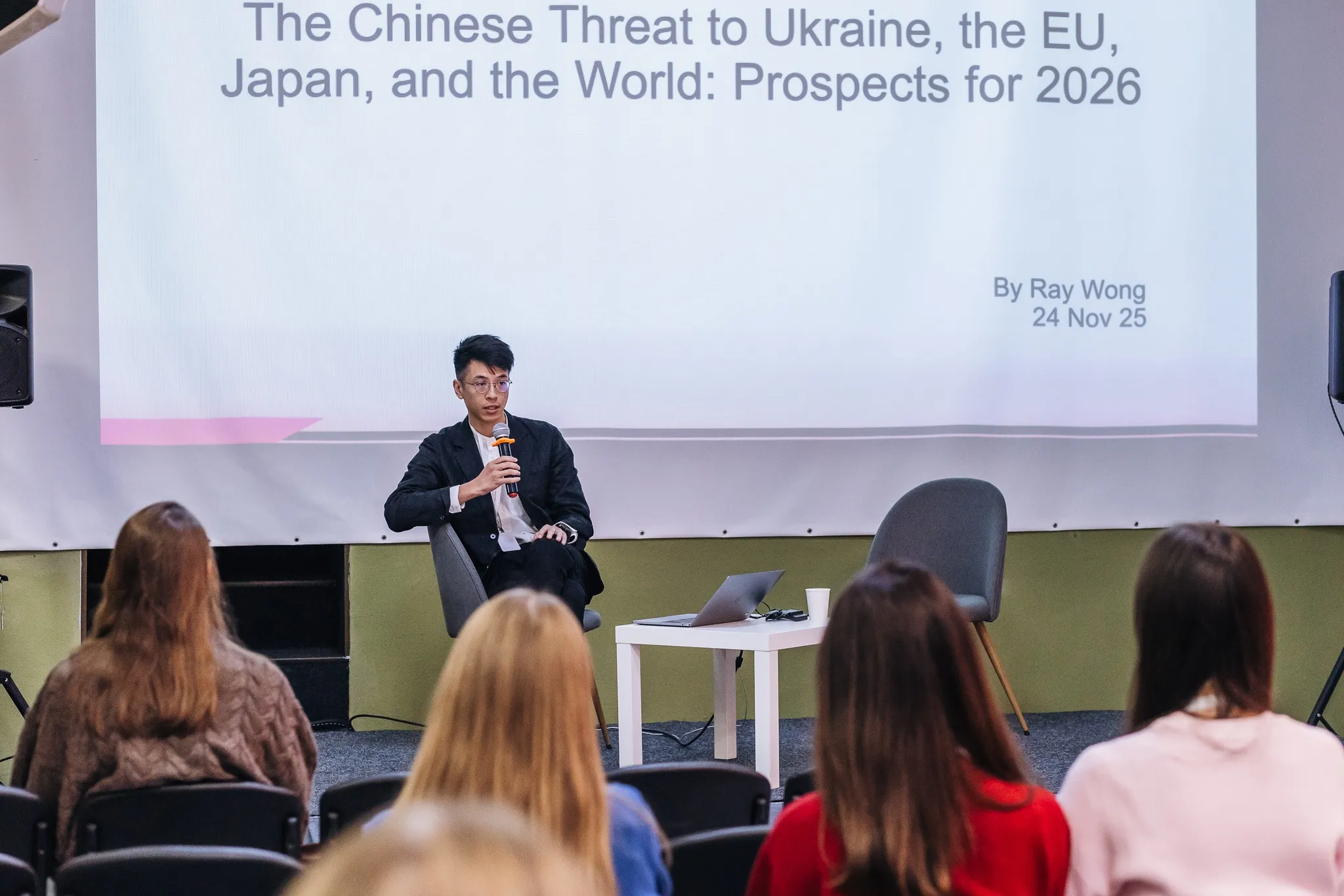
We live in a deeply globalized world. Indifference to authoritarian regimes today has consequences tomorrow. Hong Kongers learned that lesson the hard way – and Ukrainians, especially in the diaspora, understand it just as clearly.
A Blind Economic Zone: How Is Russia Circumventing Western Sanctions Through Hong Kong?
You co-authored a report with analytical center StateWatch on how Russia bypasses sanctions through Hong Kong. Could you explain how this works from a legal and structural perspective?
Many of the electronic components used in Russian missiles and drones are produced by European or American companies. Direct sales to Russian entities are prohibited under sanctions, so Russian buyers rely on intermediaries.
Typically, this involves setting up shell companies in third countries – for example in Hong Kong, Turkey, or elsewhere. These companies act as legal buyers on paper, even though the final destination of the goods is Russia.
Russia is using common high-priority items to manufacture weapons / Source StateWatch
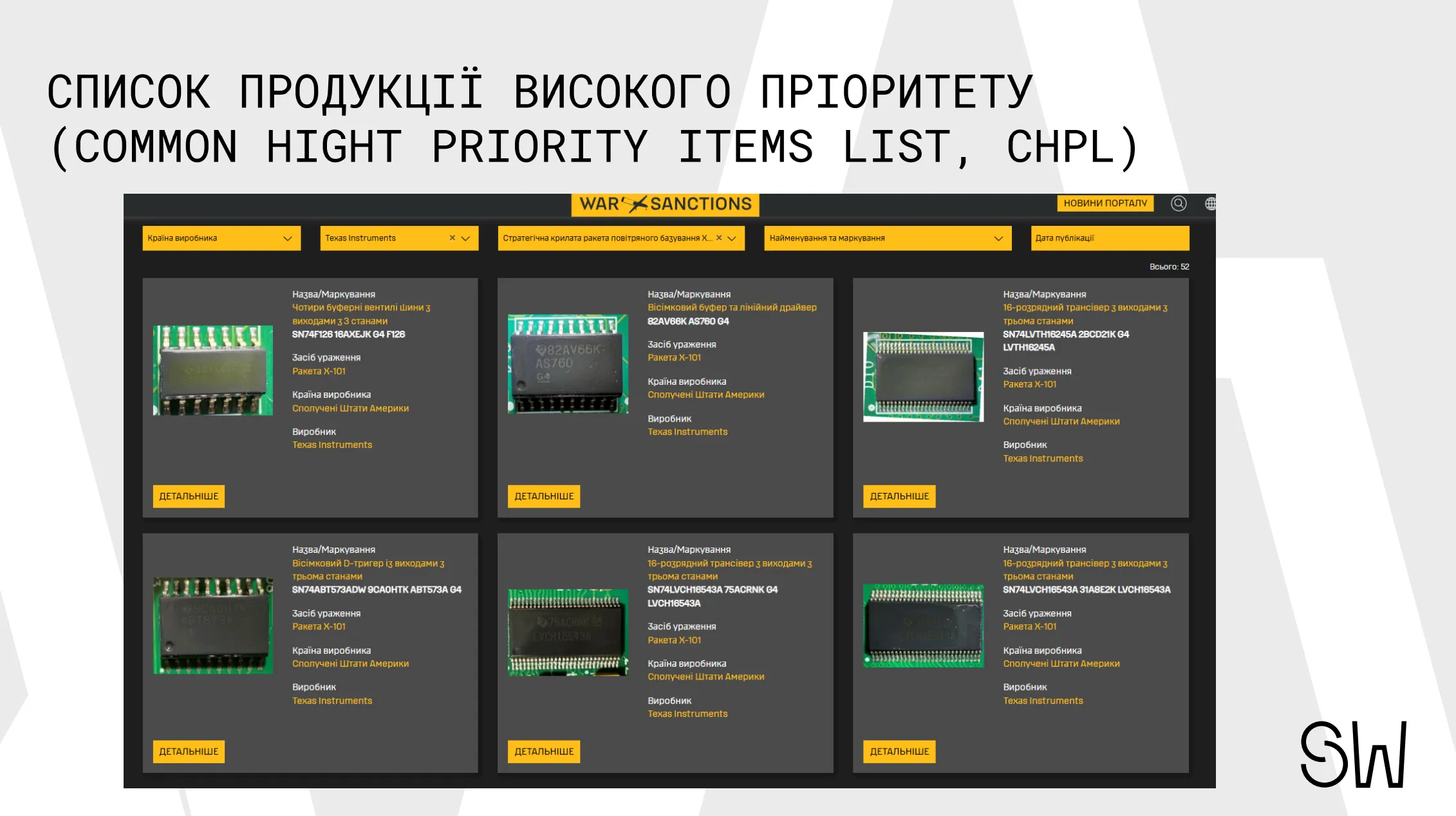
Hong Kong plays a particularly important role for several reasons. It has a business environment that is highly accessible to foreign entities, a sophisticated banking and financial system connected globally, and a long-standing role as a transshipment hub. Crucially, the Hong Kong government has openly stated that it will not enforce sanctions unless they are mandated by the UN. That means EU and US export restrictions are effectively ignored.
From an exporter's perspective, it is often easier for a Hong Kong company to obtain export licenses from Europe than for a mainland Chinese firm. If you were trying to evade sanctions, you would naturally choose a jurisdiction where approval chances are highest. There are only a few such places globally – and Hong Kong is one of them.
Once restricted goods leave Europe, it becomes extremely difficult to trace where they end up. A German company might legally sell a dual-use component to a buyer in Turkey or Azerbaijan, complete with documentation stating the goods will not be resold. But enforcing those clauses is nearly impossible. European authorities and companies simply lack the tools to monitor what happens after shipment.
This is the loophole Russian entities exploit. And the data is very clear: more than 70% of restricted goods produced in the US and Europe that end up in Russia pass through Hong Kong or mainland China. This shows just how central Hong Kong has become to sustaining Russia's war effort.
There is the concept of secondary sanctions. Why do Western countries seem reluctant to enforce them more aggressively? Is it bureaucracy, or a lack of political will?
I can't speak on behalf of governments, but from what I understand, strict enforcement requires enormous resources. Tracking transactions, supply chains, and transshipment routes is extremely complex and expensive.
Most government departments responsible for sanctions enforcement are simply underfunded. They don't have the staff or the budget to monitor such a massive volume of global trade in detail.
So in practice, even when there is political will, implementation is very difficult. It's not necessarily that governments want to ignore these loopholes – it's that closing them properly would require a level of investment and coordination that many states have not been willing or able to commit to.
You mentioned that many of the companies involved are registered to Russian citizens. If that's the case, why is it so hard to act on this information?
The problem is not a lack of information. Even if the Hong Kong authorities know that these companies are linked to Russian citizens, they are simply not going to enforce restrictions.
Under the current system, Russian nationals are legally allowed to register new companies in Hong Kong and use them to purchase restricted goods. In some cases, these Russian-owned entities don't even buy directly. Instead, they collaborate with local Hong Kong companies, which then handle procurement from foreign suppliers on their behalf.
Your report also shows that more than half of sanctioned goods passing through Hong Kong originate from Taiwan. How do you explain this, given Taiwan's opposition to Beijing?
The current Taiwanese government is not anti-China, it is anti-CCP. In the business world, some large companies are aligned with the opposition party, the Kuomintang, which is more sympathetic to Beijing and maintains close ties with mainland China.
Taiwan indirectly supplies Russia with more than half of the sanctioned goods that pass through Hong Kong / Source StateWatch

So even if the government in Taiwan has the political will to restrict exports of sensitive goods to Russia, there are companies that already disregard the current administration's position. These firms have long-standing business relationships with China and are more likely to continue selling restricted goods, even if they ultimately end up with Russian entities.
There is also another possibility: some companies may genuinely not know the final destination of their products. They sell goods to intermediaries in Hong Kong, and those shell companies can easily misrepresent their intentions – claiming the goods are for internal use or for resale to Chinese manufacturers. In many cases, Taiwanese exporters do not conduct serious due diligence to trace where the goods eventually go.
Once goods enter Hong Kong's trade and financial ecosystem, tracing their onward shipment becomes very difficult. That lack of transparency makes Hong Kong an ideal hub for sanctions evasion – regardless of the political stance of the governments involved.
Do you maintain contact with Taiwanese organizations in Europe or with official Taiwanese representations?
Yes. The Hong Kong diaspora is very closely connected with the Taiwanese diaspora. My organization has long-standing ties with Taiwanese partners, including the Taipei Representative Office in Berlin.
We attend events together, co-organize discussions, and a few years ago we even issued a joint statement responding to claims made by the Chinese ambassador. So there is real cooperation and mutual support.
That said, the nature of our challenges has diverged. Taiwan is now facing an increasingly explicit military threat, while Hong Kong is dealing with the systematic dismantling of human rights and civil freedoms. The contexts are different – but the sense of shared understanding remains very strong.
What similarities and differences do you see between China's policy toward Taiwan and its policy toward Hong Kong?
The concept of "one country, two systems" was originally designed for Taiwan. Hong Kong was supposed to serve as a model – a showcase to convince Taiwanese society that reunification under this framework was viable.
For a long time, that strategy actually worked. Before 2019, opinion polls showed that a significant number of people in Taiwan were at least open to the idea. That changed dramatically after the 2019 protests, when it became clear that Hong Kong had effectively lost its autonomy.
The Hong Kong government and police were widely seen as operating under the direct control of the Chinese Communist Party.
Every year, China is stepping up the scale of its military drills around Taiwan / Photo AP

After that, Beijing shifted its approach. The promise of "one country, two systems" lost all credibility. Since then, we've seen a much sharper rhetoric toward Taiwan, including open references to the use of military force to achieve reunification. In a sense, Beijing understands that its original proposal has gone bankrupt – Hong Kong exposed it.