


She wasn’t looking for this program. The program found her. The first message arrived on her phone from an unknown Russian number, inviting her to participate in some kind of educational project. Nia (name changed for security reasons) didn’t reply. But a few months later, they wrote again. This time she answered, and that decision cost her more than a year of her life. Today, Nia is back home in Morocco, living with panic attacks that suddenly overwhelm her in the middle of the day.
The Channel 24 team managed to speak with a former participant of the Alabuga Start program, which we reported on previously. In this report, you will find out what truly happens behind the scenes of the program and how the participants are treated there.
Read this text in Ukrainian
I thought I was going there to study. When I arrived, everything turned out to be completely different,
– this is exactly how Nia began her conversation with us.
Alabuga Start
is a Russian relocation program for young women aged 18–22 from Africa, Asia, and Latin America. Under the guise of international education and lucrative employment, they are recruited to assemble Iranian-designed "Shahed" kamikaze drones at a special economic zone in Tatarstan. Instead of the promised education and career prospects, participants effectively become cheap labor for the Russian military-industrial complex, working in hazardous conditions at factories producing weapons for the war against Ukraine. Russia uses this project not only to fill sanctions-driven labor shortages but also to use foreign citizens as a "human shield" at its strategic facilities.
Friendly Tones and Promises of Success: The Psychological Hooks of Alabuga Start
The recruiter, a woman named Razilya Sharafutdinova, reached out via WhatsApp. Her tone was friendly – informal and free of dry corporate jargon. She asked about Nia's age, interests, and future plans, framing the program not just as a job, but as a golden opportunity: specialized training, international certifications, financial aid, and a career path. Any young woman in her shoes would have believed it.
Niya was shown photos of smiling girls, tidy rooms, and the promise of a bright future. They told her, "Just bring a little money for the first few weeks; everything else will be provided." Before her departure, she was asked to record a video confirming she had read the program's terms. However, no one had actually explained those terms in detail. Her visa was processed at the embassy in less than two hours. Everything was going far too smoothly.
Quarantine or Captivity? The First Weeks Behind Closed Doors
She was met right at the airport and driven to Yelabuga, on the outskirts of which lies the "Alabuga" Special Economic Zone in Tatarstan. It is here, amidst industrial buildings and guarded perimeters, that participants of "Alabuga Start" work – a program branded as an educational initiative for international students. Immediately upon arrival, Niya’s passport was confiscated. Staff claimed the document was being sent to the migration office in Kazan to process her work permit. There was no indication of when she would get it back.
Niya and the other participants spent their first month confined to a cramped room. The official reason was "quarantine" for infectious disease screening, despite each girl providing valid medical clearances from home. They were fed once a day, and sometimes not at all. Niya describes it bluntly: "We ate just enough to stay alive." They were forbidden from buying food with their own money, and their pleas fell on deaf ears. Some girls even begged the guards to let them take out the trash just so they could scavenge in the bins. Several times, "fire alarms" went off in the middle of the night. With no clear instructions, the girls were simply forced outside, where they spent hours in the cold, confused and terrified.
Since the Alabuga SEZ is a key hub for manufacturing Shahed-type UAVs, the Ukrainian Defense Forces regularly and precisely target the workshops and facilities directly linked to the production of these strike drones. Every foreign woman lured by Russia to this site effectively becomes not only an accomplice to the aggressor but also a potential victim at a legitimate military target.
Notably, during a Ukrainian drone attack on June 15, 2025, one factory worker was fatally wounded and several others were injured.
A photo taken by Niya from a "shelter" in the aftermath of a strike on the Alabuga SEZ, March 15, 2025 / 24 Channel

Later, during alerts, they began sending the girls to underground shelters. However, the fact that as late as 2025, the Russians were using open fields as "shelters" speaks volumes about both their attitude toward the participants and their use of them as "human shields." In the event of their deaths, Russia would label Ukraine a terrorist state and accuse it of deliberately targeting foreign nationals. Furthermore, a memorial plaque stands on the grounds of the Special Economic Zone, commemorating the Ukrainian Defense Forces' strike on April 2, 2024. This is the ultimate embodiment of the cynicism inherent in Russian propaganda.
Photo of the "memorial" plaque at the Alabuga SEZ / 24 Channel


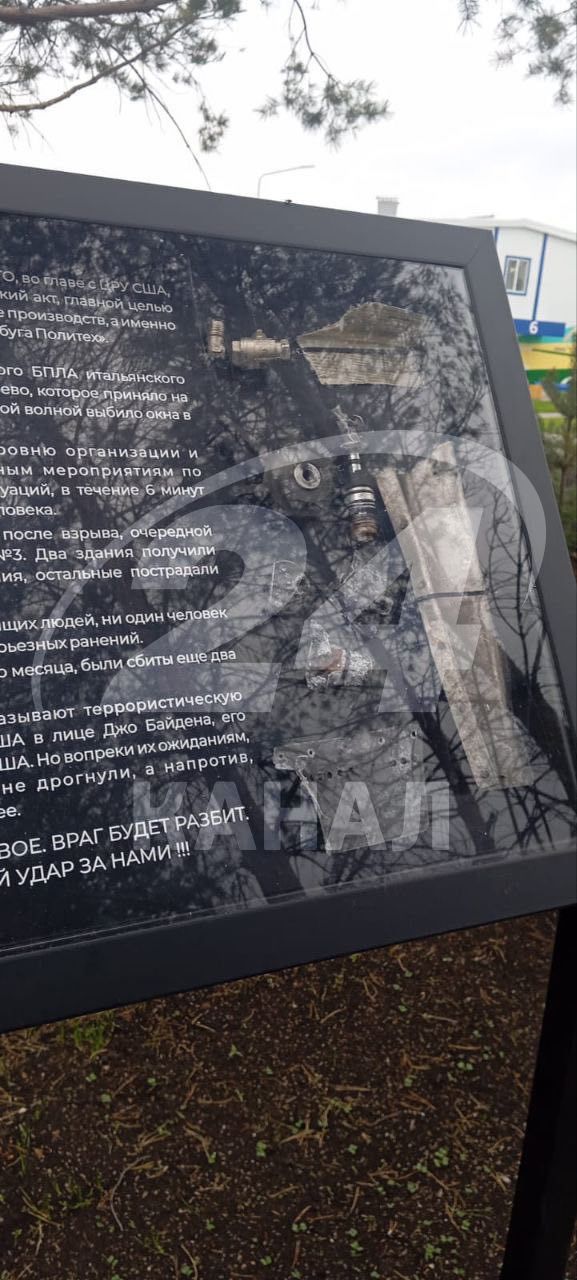
The text on the plaque pathetically blames "NATO forces led by the US CIA" for committing a "terrorist act" on April 2, 2024. It claims the primary goal of the attack was not the destruction of military production, but the murder of "peacefully sleeping students."
The chronology of events – from the first UAV strike at 5:04 AM to the evacuation of 543 people–is presented as an act of leadership heroism, culminating in an aggressive slogan: "OUR CAUSE IS JUST. THE RETALIATORY STRIKE WILL BE OURS!!!" However, behind this granite facade hides a grim reality: the SEZ administration deliberately uses foreign girls as "human shields" by placing their dormitories directly adjacent to the workshops manufacturing strike drones. What was promised as a prestigious "start" to a new life has, for hundreds of students, turned into a mix of quarantine and captivity at a "death factory," where human life is worth less than a drone assembled on schedule.
This plaque is not an act of remembrance; it is about psychological pressure and an attempt to turn every potential tragedy into another propaganda headline, while turning a blind eye to the fact that the youth here are merely expendable cogs in the machinery of war.
Deadly Labor: How the Dream of a Job Became a Fight for Survival
After Niya’s arrival, she was informed that there were no longer any openings in catering – the field she had been contracted for – as the positions were already filled. She was offered a different role, but Niya refused, as it did not align with her original contract terms. Despite this, she was frequently forced to perform tasks not specified in her contract, including cleaning and various organizational duties. On some days, she was also sent to work alongside other girls on the drone production line.
After the first month, the girls were moved to a different location and put to work. The workday began at six in the morning and lasted until nine in the evening, sometimes stretching until midnight. The exhaustion was so severe that several girls fainted on the job.
According to Niya, the conditions and overwork sometimes led to even more dire consequences. She claims that after she managed to leave the program, at least two participants from Africa died.
The first girl died, but HR told her roommates not to speak a word of it to anyone,
– Niya recalls.
According to Niya, a second death occurred less than two months later. This time, the news had already spread among many of the program’s participants. The foreign women were told that both deaths were caused by illness; however, no further details or explanations were provided. The news never leaked beyond the perimeter of the Special Economic Zone.
Working conditions differed significantly from those specified in the contract. Their tasks included assembling drones using hazardous materials, working overtime across various production and service sectors, and cleaning toilets.
For the first three and a half months, Niya did not receive a single payment. When her own savings ran out and she asked for permission to go to a bank to receive a transfer from her family, she was refused. It was explained to her that participants were not allowed to move about freely.
The Golden Cage of Drones: Confiscated Passports and Forced Propaganda
The participants' phones were taken under the pretext of issuing new SIM cards. Using their own SIM cards was strictly forbidden. Niya suspected that her device was being monitored.
When a journalist from a German newspaper reached out, she didn't dare tell the truth. She feared her messages were being read, feared the account might be a fake, and feared the consequences. She didn't even tell her own family anything, let alone post on social media.
This digital isolation was reinforced by strict physical surveillance: the girls' daily lives were turned into a high-security routine with a rigid curfew and constant monitoring of every movement. If a participant went out even just to buy food, she was inevitably interrogated afterward: where did she go, with whom, and why?
There were also cases of sexual harassment by HR staff, officials, and security guards.
It was as if our voices didn't exist there,
– she says.
One evening, while Niya was in the kitchen, a drunk security guard walked in. They were forbidden from locking their room doors, under the guise of "cleanliness inspections" or "emergencies."
When Niya began to complain about the conditions, she was offered a "way out." If she recruited new girls for the program, gave interviews for their channel, and posted dance videos and photos on her social media with the hashtag #Alabuga_Start, her situation would improve. Niya refused. The HR staff then decided to pressure her differently. They showed her a "Program Ambassador" certificate with her name on it – no date, no official seal, no signature. It was a sham document, designed to force her into compliance and make her recruit others. She refused again.
When Niya openly stated that she wanted her passport back to return home due to the breach of contract, a conflict with the HR department ensued. As a result, her passport was withheld for months. When she mentioned contacting her country's embassy in Moscow, she received a warning: leaving the zone was illegal, and the police would be notified.
I was terrified. I tried to reason with them in a way that would cause me the least amount of harm,
– she recalls.
Our source managed to film several seconds of the passport dispute with HR managers on video.
Conflict with the Alabuga Start HR Department: Watch the video
A photo depicting two Alabuga Start HR specialists withholding a participant's passport / 24 Channel
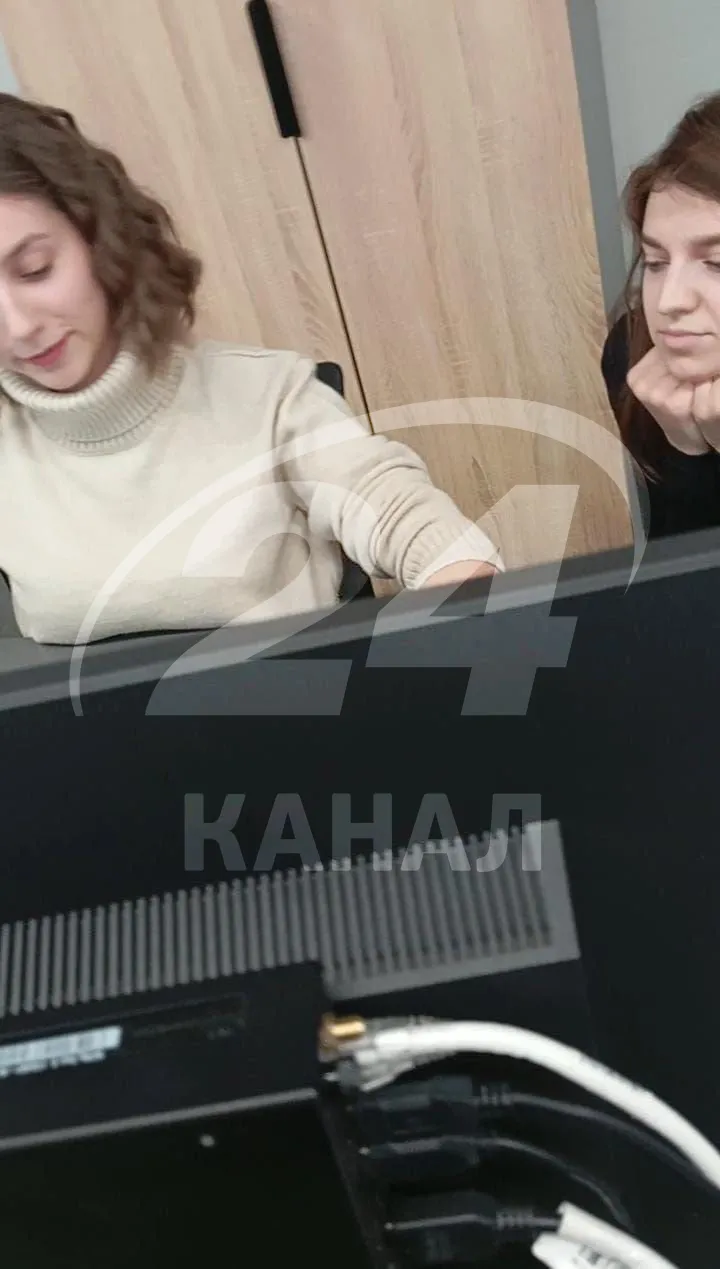
The video captures two employees from the program’s HR department identified as Razilya Gazinurovna Sharafutdinova (born October 7, 2002) and Daniela Vitalievna Davydova (born August 24, 1999). According to our source, they were the ones who confiscated her passport, citing "unspecified suspicions." The Alabuga Truth project has previously published information on the program’s HR staff, including the individuals featured in the video.
A screenshot of the Alabuga Start HR staff list / Alabuga Truth

"Tatarstan’s Golden Cage" turned out to be a trap with no escape, where sexual harassment and psychological terror are woven into the corporate culture. Niya managed to save video evidence and break free, but hundreds of other girls remain behind closed doors. Their voices are systematically silenced, and their faces are used to create the illusion of "happy international cooperation" – all at gunpoint.
$2,500 for Freedom: A Ransom from Russia
She lost precious time, but in the end, she managed to escape what she describes as a "highly dangerous and toxic situation." According to Niya, she realized at a certain point that open conflict would only worsen her predicament. Instead, she chose a different tactic.
I told them I couldn't work because of an illness and acted as if I were truly in a very bad way,
– she recalls.
During this period, they stopped paying her altogether since she was no longer working. Eventually, the management deemed her of no further use. They told her she could leave, but only at her own expense.
Niya suggested that her family simply buy her a plane ticket home. However, she was told that her relatives had to send the money directly to Russia. According to her, the program staff were well aware that doing so from her home country was extremely difficult. As a result, her family had to find a workaround. The money was first sent to an acquaintance in Turkey, and from there, it was transferred to Russia.
I went with an HR staff member to collect the money, and after that, I was finally able to return home,
– Niya says.
In total, her family managed to send her about $2,500, which she used to secure her departure.
After eight months in the program, she finally managed to return to her home country. Today, things are difficult for her. Panic attacks strike unexpectedly, yet she still agreed to speak out.
Niya's experience proves one thing: "Alabuga" is not about a "start" – it is about survival. What began as a dream of an international diploma ended with the forced assembly of murder weapons and a $2,500 ransom for her own passport. Russia has once again demonstrated that for its regime, there are no borders, laws, or moral norms when it comes to fueling its war machine. Niya's return home is a miracle, but it must serve as a lesson. No promise of a high salary is worth becoming a cog in a mechanism of aggression where your life is treated as nothing more than "expendable material."