




Russia is weighing plans for a potential invasion of a NATO member state, as Donald Trump appears to be doing everything he can to weaken the Alliance. The U.S. president has announced the withdrawal of 5,000 American troops from Germany. It remains unclear whether these forces will stay elsewhere in Europe, but confidence in the American security umbrella is clearly eroding.
24 Channel spoke with Gen. Ben Hodges in an exclusive interview – a retired U.S. Army officer and former commander of U.S. forces in Europe – to assess Trump's recent moves, whether Europe can defend itself on its own, and what real security guarantees for Ukraine should look like.
Trump's NATO Exit Threat: How It Plays Into Russia's Hands If Russia Strikes
I want to ask about current US-NATO relations. How do you assess Donald Trump's rhetoric about a possible US withdrawal from NATO, given his decision to withdraw 5,000 US troops from Germany? Is this still political pressure, or a real strategic threat to the Alliance?
First of all, I take it seriously. The president's directive to remove 5,000 troops from Germany – what we're really talking about is a brigade stationed in Bavaria – could happen within the next 12 to 18 months.
There are a lot of complications here, but I would take it seriously unless Congress really steps in, and that seems unlikely.
The question is: do they move this brigade to Poland or Romania, or do they go home to the United States? That's not clear. And I think the lack of clarity reflects the absence of a coherent strategy – there's no clear vision of how this improves the US strategic posture.
It looks more like petty retribution against the German Federal Chancellor insted of a thoughtful strategic move. Of course, with President Trump, there's always more to it. You're never entirely sure what he means or what he's going to do. But usually, he is goona do things in a transactional way, and also, usually he is going to do thing to benefit Vladimir Putin more than anyone else. That part is very concerning.
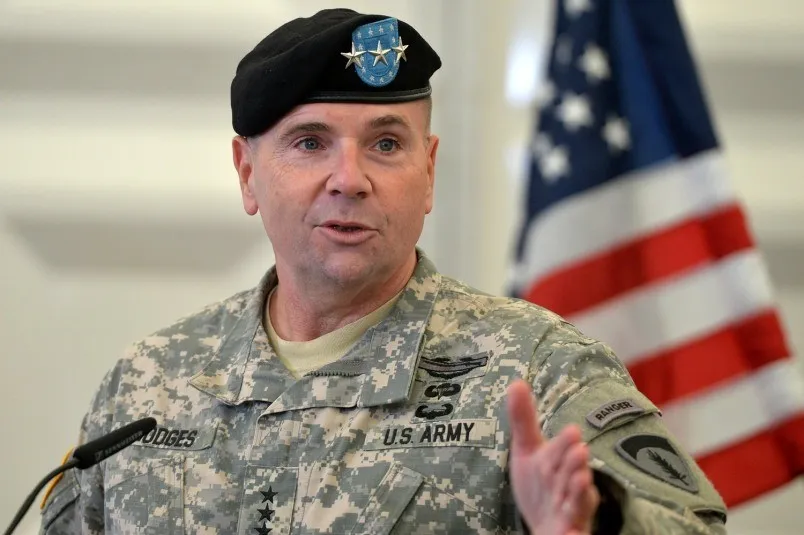
Lieutenant General Ben Hodges during his service / Photo US Embassy
As for the Alliance, he has been talking about leaving NATO for many years. By now, I think most of European leaders almost shrug their shoulders and assume this could eventually happen. It would hurt the United States more than Europe, but it is still a real possibility.
At the same time, European leaders recognise that is possibility and that their best chance to protect Europe from a Russian invasion is to help Ukraine defeat Russia. That's what we're seeing from Germany, as well as other European countries – helping Ukraine is the best way to protect the rest of Europe from Russia.
Does the US president actually have the authority to make such a decision and how could he bypass resistance from the US Congress?
The president does have the authority to do something like this.
The latest National Defense Authorization Act – which is the annual defense bill – said that the president cannot reduce troop levels below a certain level without coordinating with Congress. This reduction of 5,000 troops does not meet that threshold, so yes, he can do it.
But I think the president and his administration have no respect for Congress anyway. They freqently look for ways to get around legal constraints.
Unfortunately, the current Congress, led by Republicans, is unwilling on most things to actually stop, to push back the president or publicly go against him.
But we have a different dynamic this year, with midterm elections coming up in November. Eather Republicans who are running for re-election will hear from their voters, one way or the other, or Democrats could take control of Congress and act more assertively and muscular.
But we won't know that until after November.
During the escalation around Iran, US allies did not support Washington as the White House expected. Donald Trump also blames Europe. Do you think that's fair, given that the United States did not warn its allies about the strike?
I think it is completely unfair for the president to blame allies for not supporting this attack on Iran. They were not involved in the attack, and they were not meaningfully consulted in advance.
Now, because things seem to be going poorly in the region, the president is looking for others to blame – trying to divert the attention of American voters from this terrible strategy by blaming Europeans.
On the other hand, this is not really about fairness – it's about best strategic interests. And I think some Europeans could have been more clever, like Spain or Italy and a couple of others. Not because they are afraid of Trump, but because they do benefit from US operations in the region.
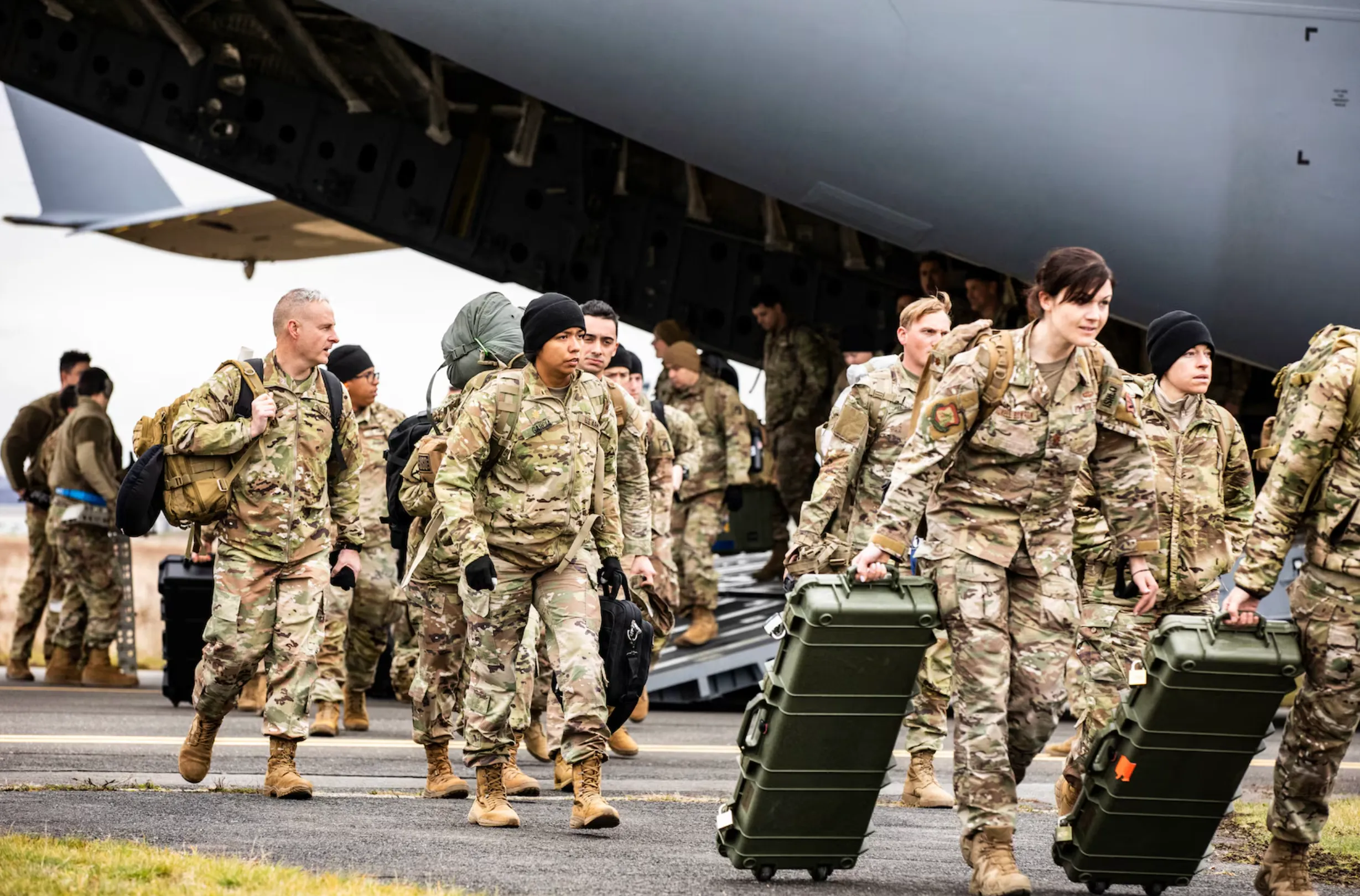
U.S. forces were deployed to Europe as part of NATO reinforcement amid Russia’s aggression against Ukraine, 2022 / Photo U.S. National Guard
This makes it easy for President Trump to get people angry towards Europeans, because they do benefit and now they all feeling the consiqences of this situation where they had at least allowed the US to operate out of the bases in Spain, for example. It would have reduced their vulnerability of pressure from President Trump.
At the same time, I think that this is eventually going to backfire on us, on the United States. Because more and more European countries are realizing that they cannot fully trust President Trump. We can this in tarrifs and economic relations.
The fact that the president now blames them – combined with the reality that the Secretary of Defense, Mr. Hegseth, clearly does not truly understand how NATO works, nor does he care – Europeans going to become more and more more self-reliant.
And this will damage US strategic interests, including its ability to operate in Europe and maintain strong economic ties. So overall, I would say this has been poorly played on both sides.
If Russia Strikes Europe, Can NATO Hold Without the United States?
We are also seeing reports about possible Russian attack scenarios against NATO countries, including, for example, Estonia or Finland. How realistic are these scenarios from a military point of view, especially while the war in Ukraine is still ongoing?
I think these scenarios become realistic if Ukraine begins to fail.
If Russia sees that Ukraine is running out of capabilities, and if it believes that the United States will not going to do anything. If they are confident theat the US not going to act in Europe. The same applies if the UK continues to weaken and if divisions within Europe persist. Then I think the risk goes up.
If Europe did not become more aggressive in countering Russia's gray-zone operations – sabotage, drone activities, airspace violations, and other forms of hybrid pressure. If Europe does not realise how to become more aggressive, to push it back or stop it, than I think the Russians become emboldened to escalate further.
That, in my view, is the more likely scenario.
At the same time, i think European leaders are wise to contemplate the very real possibility of a Russian ground attack – for example, in places like Daugavpils in Latvia, or in Estonia or elsewhere.
They should also be aware if Russia decide to do that, it would likely be accompanied by massive drone strikes against airports and seaports across Europe – on a scale similar to what we see in Ukraine.
And I don't think Europe is fully prepared for that yet.
If Russia attacked Estonia or another Baltic country – or Finland – and Donald Trump refused to respond, what would happen then? Does NATO have a Plan B without the United States?
I would anticipate that the leadership and the staffs have at least considered such contingencies.
In each Baltic state, you don't just have only national forces – you have multinational deployments. In Estonia, Latvia, and Lithuania, there are troops from multiple countries: British and French troops, You got the Canadian, Spanish and American in Latvia. Germans, Dutch and Americans in Lithuania.
One of the potential scenarios of a Russian attack against the Baltic states and Poland

So it's not inconsequential and you also got air forces of the Alliance, including the strong air forces from Sweden, Finland, and Norway.
So I would not assume this as a handful of isolated Estonian troops near Narva. It's a more complex and prepared defensive structure – but still this is not enoght.
The biggest vulnerability, in my view, would be the absence of US air power. That is something Russia would try to exploit.
This is why allies need to recognize these gaps and do things to be prepared – especially in air defense, which remains a major weakness.
If Russia ever made the mistake of attacking Finland again, they would be severely defeated. Finland is extremely well prepared. It has strong mobilization systems and one of the largest artillery forces in Europe. I think Russia would not make that mistake again.
You served in the US Army and commanded in Europe. How do your former colleagues in the Pentagon see what's happening now? They stay quiet publicly – but what do they really think about the current situation?
I think most people are deeply concerned about what the president and Secretary of Defense, Mr. Hegseth, are doing.
There is concern about the failure to support Ukraine and the failure to maintain strong relationships with allies. I mean, It's okay to criticize allies for not doing enough – that's fair. But breaking trust is hurts us, because the United States depends on access provided by European allies.
Also, about half of the intelligence we rely on actually comes from allies, not from US satellites. So this relationship is essential. I think many of my fellow retired officers are very concerned about that.
There is also concern about pressure coming from Secretary Hegseth on military personnel to carry out actions that could be illegal – for example, ideas like attacking Greenland or targeting drug boats at sea in ways that could be considered extrajudicial killings.
This is sllegal, but the disdain that Mr. Hegseth has for the law and rules of engagement, which is deeply troubling for most retired senior officers.
They understant that the oath that we took our entire career was to the Constitution, not to the president. And this administration is trying to shift that toward personal loyalty to the president. And I think this is sickening for all of us.
If Not US Guarantees, Then What Secures Ukraine?
Trump has often promoted the idea of pulling Russia away from China, even at the cost of concessions on Ukraine. How realistic is this approach in today's geopolitical context?
It's a stupid idea. It shows a fundamental misunderstanding of what Russia is and who Vladimir Putin is.
Putin is not going to become a reliable partner or ally of the United States. Russia has one interest – and it is the destroying NATO and to drive a wedge between the US and Europe. And Donald Trump is doing it for them them.
Russia and China hold joint military drills / Photo AFP

At the same time, China does not see Russia as an equal or as a reliable ally. It sees Russia primarily as a source of energy and natural resources, and likely has long-term ambitions to increase its influence over it.
I don't subscribe the idea that somehow we can "peel Russia away" from China. Russia is unlikely to change unless it suffers a decisive defeat and the current regime collapses.
Only then there is a chance for a different kind of Russia emerge. Otherwise, whoever comes after Putin is likely to pursue the same goals – including aggression against countries like Estonia, Latvia, and Lithuania, and continued war against Ukraine.
I think this is very implausable strategic approach.
Do security guarantee negotiations for Ukraine make sense at all if the key guarantor – the United States – is itself questioning its role in European security?
I think what President Stubb said recently is absolutely right: Europe needs Ukraine more than Ukraine needs Europe.
What Ukraine has accomplished over the last several months, not just the last years, but the last months – is remarkable. It's clear that the momentum has shifted in Ukraine's favor, and I hope that this continues.
That doesn't mean Russia will stop killing the inocent Ukrainians at night in their apartments. But the momentum has changed and more and more people around the world recognize that Russia cannot actually defeat Ukraine.
So what should we do in the long term?
I think the path to victory for Ukraine is in destruction of Russia's oil and gas export capability. If Russia cannot export their energy to countries like China, Turkey, or India, or anybody else it becomes much harder for Russia to continue the war.
I would applaude the current approach Ukrainian side and would encourage European countries to invest more in Ukraine's ability to develop long-range precision strike capabilities.
At the end of the day, I don't know that NATO membership is gonna happend in the near future. It's not only the United States – some other countries are also relected.
I do hope Ukraine joins the EU sooner rather than later. But regardless, Ukraine must ensure its own security.
There are no security guarantee otherwise.
That means maintaining a strong and capable military, along with an effective mobilization system. That way you could grow the militaty very quickly with women and men who are trained and ready – similar to Israelis model.
It also means building a powerful domestic defense industry, so you could produce everything you need for yourself reducing dependence on foreign weapons.
Also the intelligence services will continue to be an important part of Ukraine's security – continuing to hunt down Russian officers who were responsible for any war crimes against Ukrainian people. They should for the rest of their lives be worried about "GUR" (Defense Intelligence of Ukraine) hunting them down just the way Hesblollah is worried about Israeli Mossad hunting them down. Forever.
And of course, it's about society as a whole. This war will end one day somehow, but making sure that Ukrainians still are committed, have a stake in it. I don't think soldiers who have been doing what they're doing or families who have sacrificed so much are going to accept going back to the way it was 10, 20 years ago in Ukraine.